
By Kelly Teal, Contributing Analyst
SMB Group
With new packaging, AI-driven deployment, and a simplified delivery model, Workday is addressing long-standing SMB barriers with its GO Platform. However, affordability, ROI clarity, and ecosystem execution remain critical to proving the offering at scale.
For years, Workday has faced a persistent perception challenge in the SMB market: that its technology, while powerful, was built for large enterprises – with the cost, complexity, and deployment overhead to match. Recall that, at Workday Rising 2025, the company made it clear that it intended to change that narrative. The question now is whether Workday GO, particularly with its emphasis on AI strategy, represents real momentum, or a reframing of the same challenges.
The answer, at this stage, is both.
What Workday Is Getting Right
At its core, Workday GO is not a new product; really, it’s a new delivery model, and that’s a critical distinction. Rather than introducing a separate “midmarket edition” of its longtime human capital management software, Workday is keeping a single code base across customer segments. At the same time, the company is rethinking how the platform is packaged, deployed, and managed for organizations with 500-3,500 employees, even as its current Workday GO iteration best fits the 500-1,500 employee range.
That’s a positive because Workday is avoiding a common problem in the SMB market: forcing customers into a lower-tier product that eventually requires migration. Instead, Workday is aiming to make its enterprise platform operationally viable earlier in a company’s growth curve. To achieve this, Workday has anchored GO in three principles: simple to buy, simple to activate, and simple to own.
In practice, that translates into several meaningful shifts:
- Simplified packaging and pricing to reduce friction in the buying process
- Preconfigured deployments designed to standardize 80–90% of implementation
- Low-cost, fixed-price deployment options, including subsidized services in the near term
- Streamlined administration, aimed at smaller IT teams, or even solo administrators
These changes directly address one of Workday’s biggest historical barriers in the midmarket: the time, cost, and unpredictability of deployment.
Just as importantly, Workday is pairing this delivery model with a growing set of AI capabilities centered around its new Sana platform.
Sana: From AI Feature to Operating Layer
Notably, Workday is positioning Sana not as a bolt-on assistant, but as the interface and orchestration layer for its technology going forward. Instead of navigating traditional menus and workflows, users interact with a conversational interface that can do the following:
- Retrieve information from Workday and connected systems
- Execute tasks across HR and finance workflows
- Automate multi-step processes
- Generate reports and insights on demand
More to the point, Sana is designed to operate within Workday’s core data, security, and process frameworks. This inherently addresses the lack of context and governance that limit many AI tools.
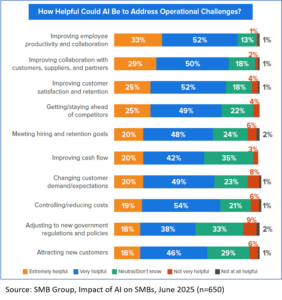
For SMBs, though, the more immediate impact comes on the operational side. For instance, deployment agents already are being used to accelerate configuration and implementation. Similarly, the Workday Admin Experience Agent reduces both external and internal resources required to manage Workday. And AI is embedded into the platform via usage credits, which lowers the barrier to experimentation.
These capabilities suggest that Workday is not just using AI to enhance the user experience. Ultimately, the company is betting on AI to fundamentally change the economics of implementation and ownership. That’s a smart and necessary
move.
Where Gaps Remain
Despite this progress, Workday has yet to wholly address the concerns outlined in last year’s SMB Group analysis, particularly around affordability, ROI clarity, and ecosystem execution.
Yes, Workday is improving its affordability for SMBs, but those efforts are not yet completely proven. Workday continues to subsidize GO deployments to make the model more attractive. That may help drive adoption in the short term, but it raises the question of whether the model can sustain itself once those subsidies are removed. For SMBs, affordability is about much more than entry price. It’s total cost of ownership over time. For now, that part of the Workday GO story is still evolving.
In addition, Workday GO ROI remains more implied than demonstrated. The company certainly has taken a step in the right direction by bundling AI capabilities (via usage credits) into GO packages. However, Workday has not yet provided clear ROI benchmarks, diagnostic tools to measure impact, or repeatable frameworks for value realization.
At this stage, the value proposition largely revolves around a “use it and see” approach. That may suffice for early adopters, but a broader swath of SMBs will require more structured guidance and proof.
Next, Workday’s partner model serves as a double-edged sword. The company is tightening control over its deployment ecosystem, limiting partners and enforcing standardization. There are merits to this, especially when it comes to consistency and cost control. However, going narrow also introduces risk, including:
- Limited partner capacity that could constrain scale
- Reduced flexibility that may not fit all SMB use cases
- Execution quality that will depend heavily on partner alignment
Understandably, Workday is trying to balance standardization with real-world variability. This very challenge has tripped up many vendors in this segment, so Workday must show that it can navigate those issues with more finesse and deliver the successful outcomes it touts.
Finally, Workday GO is an evolving product. Workday continues to roll out financials packaging, develop industry-specific capabilities, and gather customer proof points. GO remains a work in progress, which means SMBs interested in exploring the solution must understand the product direction and availability schedules.
The Key Drivers of ROI in a Workday GO + Sana Solution:
When evaluating ROI, SMBs can evaluate these value drivers tied to Workday GO + Sana:
- Legacy system decommission — GO bundles HR and financials, which should allow SMBs to retire standalone payroll, time tracking, or finance tools. In most cases more than 50%-75% of the current system cost is eliminated.
- HR admin automation — Sana’s 300+ self-service skills deflect routine tasks (policy lookups, time-off requests, payroll queries) that currently consume HR staff hours. This enables reduction in manual task time.
- Consultant dependency reduction — GO’s preconfigured deployment model plus Sana’s admin agents directly attack the ongoing consultant spend that has historically made Workday expensive to own.
- Retention improvement — Better HR tooling, faster onboarding, and Sana Learn’s personalized development pathways correlate with turnover reduction. For SMBs where replacement costs run percentage of salary, this is often the largest single ROI driver.
- Manager self-service deflection — Sana allows managers to get answers, run reports, and complete approvals without routing through HR. Modest savings per employee, but it scales.
Perspective
Workday has made real strides in addressing the structural barriers that historically have limited its reach in the midmarket. The shift to a packaged, AI-assisted delivery model, combined with a unified platform and growing ecosystem, represents a credible attempt to bring enterprise-grade capabilities to SMBs in a more accessible way. But Workday still is testing that model. To deliver on its SMB ambitions, the company will need to progress in three key areas:
- Proving affordability at scale, beyond subsidized deployments
- Making ROI visible and measurable, not just assumed
- Ensuring consistent partner execution, without sacrificing flexibility
Until those pieces are all in place, SMBs should view Workday GO as a promising direction more than a final answer. For SMBs evaluating their options, that means weighing not just what Workday GO offers today, but how quickly the model is likely to mature. All in all, Workday’s strategy is sound. Now all eyes are on the execution.