
By Kelly Teal, Contributing Analyst
The last thing midmarket companies need is another AI demo. They need AI they can use without hiring more people, stitching together more integrations or betting on outcomes they can’t afford to get wrong.
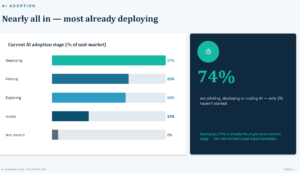
The stats back that up. SMB Group’s 2026 survey of 389 midmarket technology decision-makers found that 74% are piloting, deploying or scaling AI. Yet 44% say AI and machine learning is their scarcest skill, 35% cite integration with existing systems as an adoption barrier and 25% have yet to identify a convincing ROI or business case.
That’s why Acumatica’s 2026 R2 release deserves attention: it brings more AI into the ERP environment customers already use. AI Assistant, experimental in 26R1, reaches general availability in 26R2. Users can query company data, from finance balances, reconciliations and aging to manufacturing orders, schedules and costs, and turn results into dashboard widgets. A new context-aware Help agent answers how-to and troubleshooting questions using Acumatica documentation and the record a user has open. The assistant is also vertical-aware. It draws on the generic inquiries in a customer’s Industry Edition, such as project and job data in construction, and customers and partners can add custom inquiries as needs change.
With 50% of SMB Group respondents naming data and analytics as a top area for AI value, 26R2 also extends AI Studio with more capable agentic workflows. Agents can pull data from generic inquiries, update fields and detail lines, and feed results into configured processes. In CRM, for example, AI can prioritize customer activities and generate case summaries with sentiment, suggested next steps and replies. Separately, selected inquiry results can now be stored in their own database tables, speeding retrieval for dashboards and for Model Context Protocol (MCP) connections, which give external assistants such as Claude and ChatGPT permission-controlled access to selected Acumatica data without manual exports.
These capabilities raise governance questions, especially since 35% of respondents cite security and privacy as an adoption barrier. MCP access is read-only, tied to the user’s access rights and logged for review. Agents in these workflows cannot create records or execute form actions on their own. However, the release notes flag that fields returned to agents through generic inquiries are not automatically masked, and field-level restrictions do not apply to inquiry data stored in the data warehouse. The safeguards are real, but administrators still need to be deliberate about what AI tools can access.
This is where Acumatica’s partner model matters. SMBs without dedicated AI or data teams can lean on partners to configure data access, agents and workflows, and to manage security and governance, rather than building that expertise in-house.
Acumatica also aims to lower the adoption hurdle before charging more for AI. The company told SMB Group that AI Assistant has no added Acumatica fee today, though customers must connect an LLM and provider usage can carry separate costs. The release notes describe AI Assistant features as subject to licensing, so customers should confirm how that applies to them. Acumatica does not yet have KPI data on time savings or productivity gains, but plans to study usage through telemetry, and 26R2 adds token counts that give administrators visibility into consumption. Acumatica expects to define longer-term pricing, potentially consumption, persona or outcome-based, over roughly the next year. That gives SMBs a window to find out which uses actually save time, reduce manual work or speed decisions.
Perspective
Acumatica’s bet is that AI in ERP becomes more valuable when it is deeply tied to business context: company data, workflows, permissions and industry-specific processes. As foundation models converge in capability, competitive advantage may depend on how well vendors connect them to trusted business data. Acumatica is also not handing AI unrestricted control of the ERP, and for SMBs that sequencing makes sense. Greater autonomy is only useful if data quality, monitoring and governance can keep pace.
The next test is whether Acumatica can turn these capabilities into repeatable, measurable gains without requiring customers to become AI specialists or turning every deployment into a custom project. If it succeeds, Acumatica will have a stronger foundation for expanding its AI capabilities—and demonstrating the value of more advanced offerings over time.