
For growing organizations across Southeast Asia, the question is no longer whether HR and finance systems need to modernize. It is whether midmarket organizations can deploy enterprise-grade technology at a cost, pace and level of complexity they can realistically absorb.
By Kelly Teal, Contributing Analyst
SMB Group
Across ASEAN, midmarket organizations face many of the same pressures as larger enterprises: tighter labor markets, regional growth, rising expectations for workforce and financial insight, and mounting pressure to use AI. But they often must respond with smaller internal IT and HR teams, tighter budgets and less tolerance for a lengthy implementation.
Those constraints vary by market. Singapore organizations may be especially conscious of labor and talent shortages. In Malaysia, Thailand, Indonesia and other markets, inflationary pressure, local-currency economics and comparatively lower labor costs can make adding people appear easier than investing in automation. Yet that approach becomes harder to sustain as operations grow more complex.
This is the opportunity Workday is targeting with Workday GO, a packaged deployment model for organizations with 500 to 3,500 employees. Workday is emphasizing the offering in Singapore, Malaysia, Thailand and Indonesia, while also making it available in the Philippines and Vietnam.
Moving Beyond Midmarket Compromise
Midmarket companies have historically faced an uncomfortable choice among cost, quality and scalability. Enterprise systems may offer the required depth, but appear too expensive and difficult to implement. Lower-tier products can be easier to buy, but may provide less functionality or become constraints as the organization grows.
Workday designed the Workday GO offering to address those constraints specifically for midmarket organizations. It is not a separate, reduced-function midmarket edition of Workday. Rather, Workday GO packages enterprise Human Capital Management (HCM) and finance capabilities into separate, defined offerings, along with proven practices and implementation accelerators so Workday becomes simpler to buy, activate and own. A growing company can start with the capabilities it needs, knowing it can add more later as needed, instead of having to replace the entire platform. At the same time, buyers should expect a more standardized implementation, not a custom re-creation of existing processes. That standardization can work in buyers’ favor, even if it requires them to modify or abandon familiar ways of working. Customized deployments often increase costs, stretch timelines and preserve inefficient practices. A templatized deployment, on the other hand, typically reduces the number of configuration decisions customers must make – provided the package itself genuinely fits the organization’s needs.
Defined Packages Create More Predictable Timelines
Workday GO offers separate Basic, Standard and Advanced packages for HCM and Financial Management. Customers can also deploy HCM and Financial Management packages together as a broader platform.
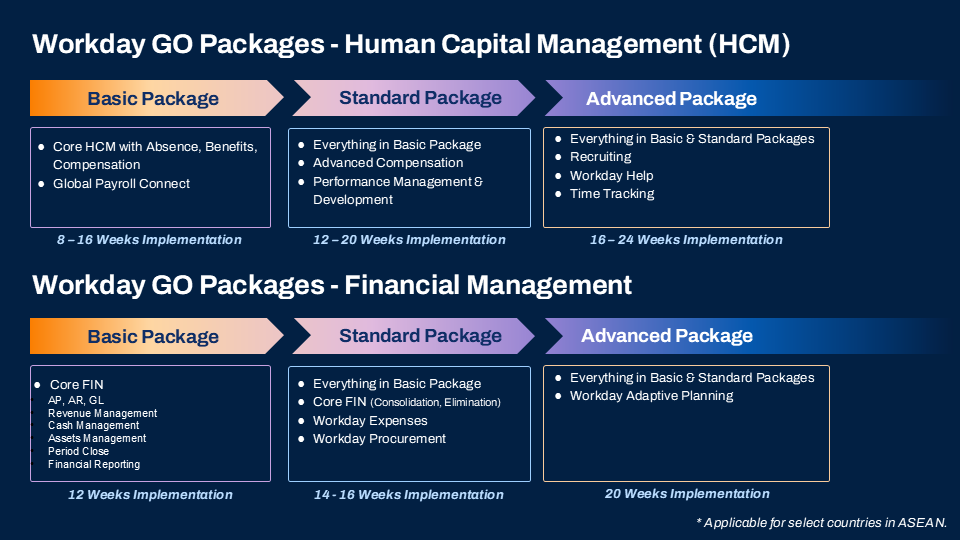
For the ASEAN market, HCM packages begin with Core HCM, Absence, Benefits, Compensation and Workday Global Payroll Connect. Standard adds Advanced Compensation and Performance and Development. Advanced adds Recruiting, Workday Help and Workday Time Tracking. Estimated implementation times range from 8 to 16 weeks for Basic; 12 to 20 weeks for Standard; and 16 to 24 weeks for Advanced.
Compensation and Workday Global Payroll Connect. Standard adds Advanced Compensation and Performance and Development. Advanced adds Recruiting, Workday Help and Workday Time Tracking. Estimated implementation times range from 8 to 16 weeks for Basic; 12 to 20 weeks for Standard; and 16 to 24 weeks for Advanced.
Source: Workday, June 2026
Workday GO for Financial Management follows a similar progression. Basic includes Accounts Payable, Accounts Receivable, General Ledger, Revenue Management, Cash Management, Asset Management, Period Close, and Financial Reporting, with an estimated 12-week implementation. Standard adds consolidation and elimination, Workday Expenses, and Workday Procurement, with a 14- to 16-week timeline. Advanced adds Workday Adaptive Planning and carries an estimated 20-week implementation.
Workday offers Workday GO Global Payroll as an optional add-on. It also offers Workday Frontline Worker, which adds scheduling capabilities and options for time-clock integrations.
The advantages of this strategy go beyond rapid implementation. Indeed, a defined scope and timeline can help a resource-constrained organization assess its implementation burden, budget more accurately and set a clearer timetable for realizing operational value and evaluating ROI.
AI Readiness Starts with Operational Readiness
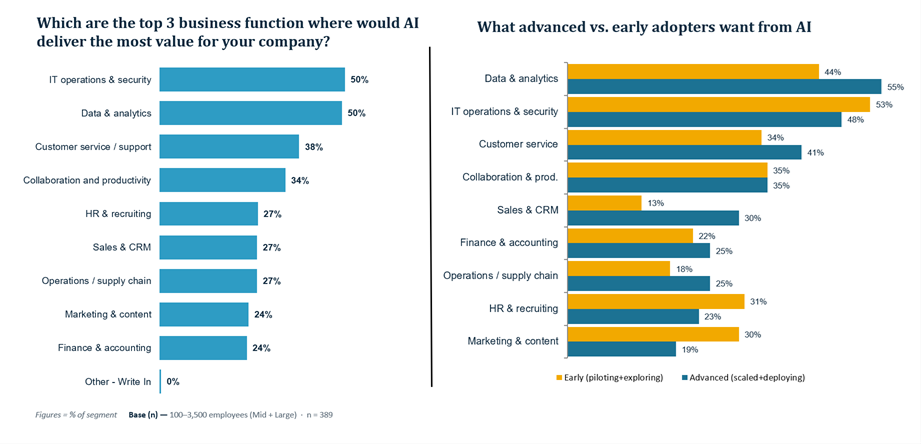
As AI becomes more common in business software and workflows, access to the technology alone is no longer the only issue. SMB Group’s broader 2026 midmarket research – not an ASEAN-only sample – shows where organizations expect AI to create value. Among 389 respondents at companies with 100 to 3,500 employees, 50% selected IT operations and security as one of the top three business functions where AI could deliver the most value. Data and analytics followed at 49.6%, with customer service and support at 38%.
Source: SMB Technology Pulse Survey 2026, SMB Group, August 2026
These survey findings reflect expected value, not documented returns. Even so, they point to strong interest in data-intensive use cases which require reliable systems, governed data and repeatable processes. Simply tacking AI onto fragmented systems and poorly defined workflows tends to preserve existing inefficiencies. Midmarket firms must first strengthen the operational and data foundation. Workday GO aims to do that through preconfigured processes, proven best practices and implementation accelerators.
Workday GO also retains Workday’s embedded AI and machine-learning capabilities. Workday Extend, which enables customers to build apps and agents, requires a separate module, additional implementation work and potentially a longer timeline. Buyers therefore must distinguish what is included in the initial deployment from what may belong in a later phase.
In ASEAN, Partner Execution Is the Model
Partner delivery is not peripheral to Workday GO in ASEAN; partners deliver every implementation, a key difference from the U.S. model. Partners enter the process early, supporting deal strategy, package validation, implementation planning and delivery. That level of involvement is essential because rapid, standardized deployment succeeds only when Workday and its partners choose the right package for each customer and identify exceptions before implementation begins.
This model also gives Workday a way to combine standardized packages with country-specific delivery capacity. But the strategy underscores the importance of partner quality and consistency, both of which are central to outcomes. Predictable timelines on paper will mean little if partners apply scope control or implementation discipline inconsistently across markets.
An early example from Malaysia demonstrates what Workday GO’s partner model can achieve. One education group moved from contract signing to full go-live in 44 days using a preconfigured Workday GO package. While buyers should not treat that result as a universal benchmark, it does show that Workday GO can compress deployment when scope, customer readiness and partner execution align.
Perspective
Workday is explicitly trying to counter the perception that its platform is affordable only for large enterprises. With Workday GO, the company says it is making subscription pricing and deployment costs more competitive while reducing the need for enterprise-sized implementation budgets.
For midmarket organizations, the relevant comparison comes down to total cost of ownership. That includes subscription and deployment expense, internal staffing demands, ongoing administration and the risk of replacing a lower-tier system to accommodate growth. Faster deployment also matters because projects that consume internal resources for months delay usable outcomes and lengthen time-to-value.
The Workday GO model represents a credible response to a real market need, but it is still developing in ASEAN. Workday and its partners will need to add more regional customer evidence, document measurable business outcomes and demonstrate consistent delivery across countries and packages to validate the model at scale across ASEAN.
Still, Workday GO directly addresses a real midmarket problem. Growing ASEAN organizations should not have to sacrifice capability or scalability to keep costs and implementation demands manageable. By combining enterprise technology with defined packages, rapid implementation and partner-led delivery, Workday is making a stronger case that midmarket buyers have a viable alternative to that trade-off.